


Is there any way to make a structure adequate in drift and displacement since after considering cracked section properties mentioned in 6.3.10.4.1 the drifts and displacements are going beyond control and building becoming uneconomic?
First of all, BNBC-2020 doesn’t explain much about his topic. BNBC-2020 gives the following guideline.
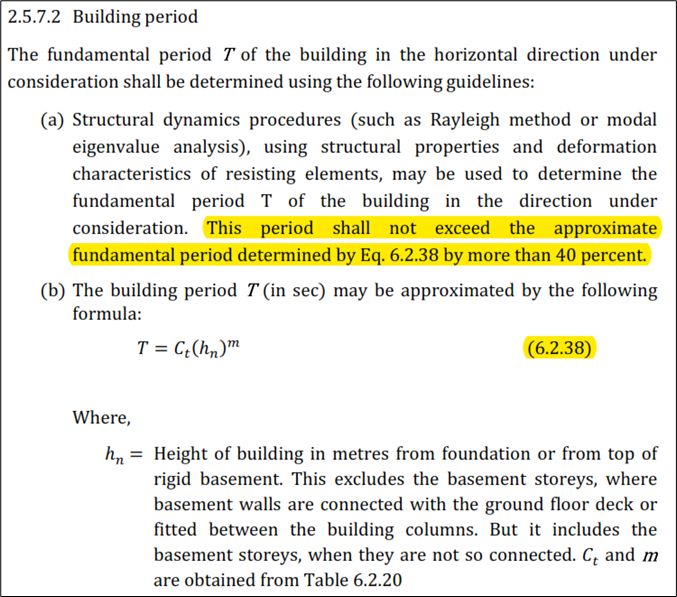
Figure: BNBC-2020 guideline regarding time period
BNBC-2020 clarifies that, time period can be obtained by either approximate method (Ta) (results in lower time period) or by a dynamic procedure (Td) (results in higher time period). BNBC also gives a limit, it says considered time period cannot be higher than 1.4 times the approximate time period (Ta) if dynamic time period is greater than 1.4 times the approximate time period.
BNBC-2020 doesn’t clarify for which type of analysis this time period limit (1.4 times Ta) is applicable.
Is 1.4 times approximate time period criteria applicable for drift and displacement check or only for structural design of members?
Maximum time period allowed by BNBC-2020 is 1.4 times approximate time period. The clarification where this cap is applicable is not clarified in BNBC-2020. ASCE 7-05 clarifies the matter.
The flowchart below can be followed for better understanding.
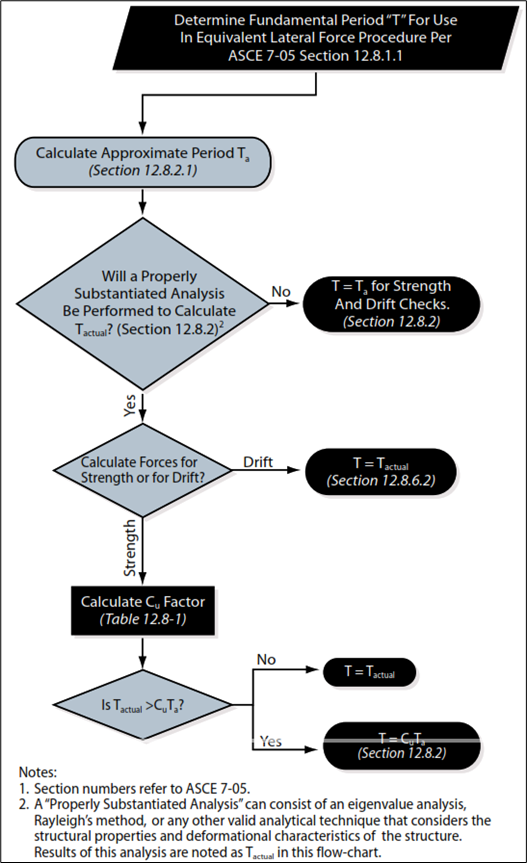
Figure: Procedure of adopting time period
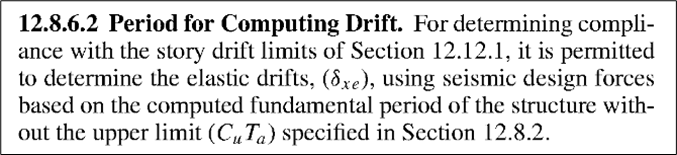
Figure: 1.4 Ta cap is not applicable for drift determination (ASCE 7-05)
Therefore, it is clear which time period is applicable for drift and what for design of members.
The dynamic time period can be calculated using eigenvalue analysis or Rayleigh’s method.
Eigenvalue analysis is performed by programs like ETABS, SAP2000 etc., whereas Rayleigh’s method is a straightforward method.
Time period calculation using Rayleigh’s method has been illustrated in FEMA 751.
